CZ
CZ  DE
DE 

The PRINCIPAL Telco Platform provides tools for working with the Diameter protocol. This protocol is one of the fundamental communication tools for selected components of telecommunications operators’ network infrastructure. Individual solutions—i.e., PRINCIPAL Telco Platform applications such as PCRF or VoLTE—are then implemented on top of this protocol. These applications already implement the selected business logic to ensure the required functionality, upon which the service is subsequently provided to the end user, i.e., the telecommunications subscriber.
The Diameter protocol is a standardized protocol, and the individual implementations of this protocol by telecommunications operators are also standardized. This standardization is typically carried out at the level of organizations in which both telecommunications operators and network equipment suppliers participate (e.g., the GSM Association).
APPLICATION PLATFORM
Thanks to its unique architecture, the PRINCIPAL Telco Platform is highly flexible and enables the creation of the required PRINCIPAL Telco Platform applications in less time and at lower cost. At the same time, it allows for the development of applications that provide functionality that is both requested by and useful to the customer. Currently, customers have the option to purchase solutions that are robust and include a large number of features, but which they will not actually use. This is also associated with a significantly higher purchase price and, at the same time, higher ongoing operating costs. Meanwhile, PRINCIPAL Telco Platform applications can grow alongside the customer’s needs. This potential for development and growth stems from another key feature: its openness. Openness is available at two levels, the first being the PRINCIPAL Telco Platform itself. Here, changes can be made at the lowest level of individual modules (libraries, SLL, configurations, etc.), thereby providing the means for PRINCIPAL Telco Platform applications. Changes at the PRINCIPAL Telco Platform level thus make it possible to modify or extend the functionality of existing applications. The second level is at the PRINCIPAL Telco Platform application level, which, thanks to its unique architecture leveraging the PRINCIPAL Telco Platform’s capabilities, is easily developable and configurable—even without the need to modify the source code directly.
Last but not least, the PRINCIPAL Telco Platform is versatile, enabling the development of any applications based on the Diameter protocol. The platform provides developers with ready-made software modules that they can simply utilize during application development without needing to understand or program the specific details. This, of course, leads to much faster development.
In terms of specific applications, the PRINCIPAL Telco Platform can be used to develop the aforementioned PCRF and VoLTE applications, as well as the so-called DRA/DAE, which is necessary for providing roaming services. It can also be used for so-called Gxx applications, which enable the deployment of various converged services—that is, services that utilize both mobile and fixed telecommunications networks. Others include applications implementing the S9 reference point (roaming support for VoLTE) and applications implementing the Sy interface (support for applications requiring online billing).
ARCHITECTURE
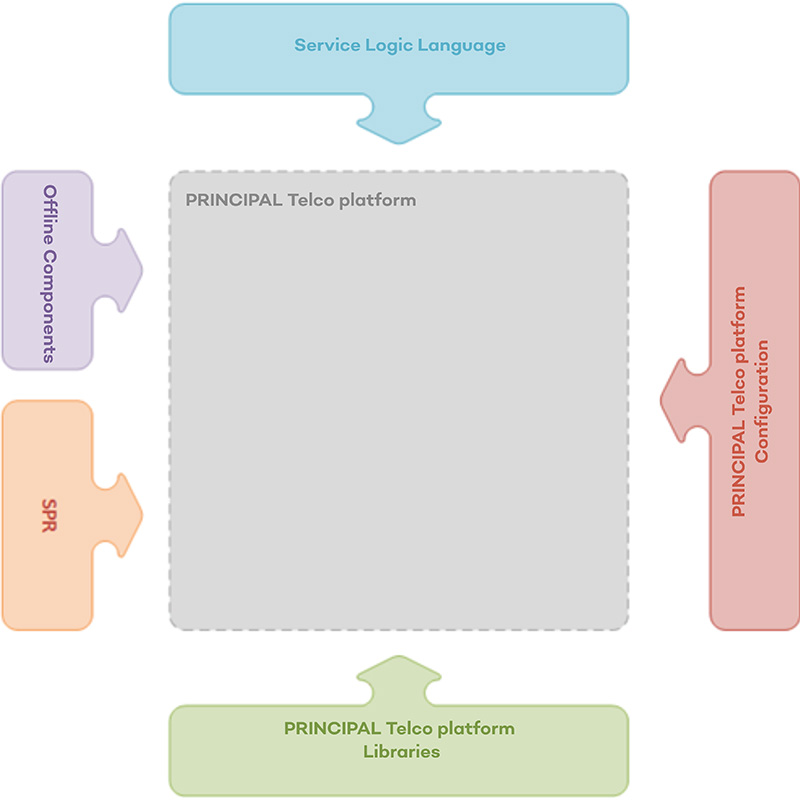
From an architectural perspective, the PRINCIPAL Telco Platform consists of 5 basic components:
- PRINCIPAL Telco Platform Libraries (PTPL)
- PRINCIPAL Telco Platform Configurations (PTPC)
- Service Logic Language (SLL)
- Offline Components
- SPR (Subscriber Profile Repository)